Featured

Overview of Confirmation Process: Actual Plan Used for Grades 3 and 4

OVERVIEW OF CONFIRMATION MINISTRY PROCESS

(Copy of actual plan used at Grace Lutheran in Hermantown,MN)

THIRD GRADE

WORSHIP:  Fifteen (15) Worship Units earned.

SUNDAY SCHOOL:  Fifteen (15) Sunday School Credits earned.

CONFIRMATION UNIT: 

Enrollment Service & Receive Bibles (October)

Learning:  Liturgies for Worship. (January Sundays)

  • Sunday 01:  Parent/Student intro to Organ led Worship
  • Sunday 02:  Parent/Student intro to Praise Band led Worship
  • Sunday 03:  Lead Narrative Worship Service at both Services

Serving:       

  • Sharpening pencils, straightening Bibles & Hymnals and  marking Lessons for upcoming Sunday in Lectern Bible.

TIF Unit*:  The Bible: selected Bible verses read together @ worship.

  • Parent/Student classes during Sunday School on three consecutive Sundays in November.
  • Participation at Worship: Reading of selected Bible verses, selected to parallel Lessons & Gospel for the day.

FOURTH GRADE

WORSHIP:  Fifteen (15) Worship Units earned.

SUNDAY SCHOOL:  Fifteen (15) Sunday School Credits earned.

CONFIRMATION UNIT: 

Devotional Reading of the Bible  (During January)

Learning: 

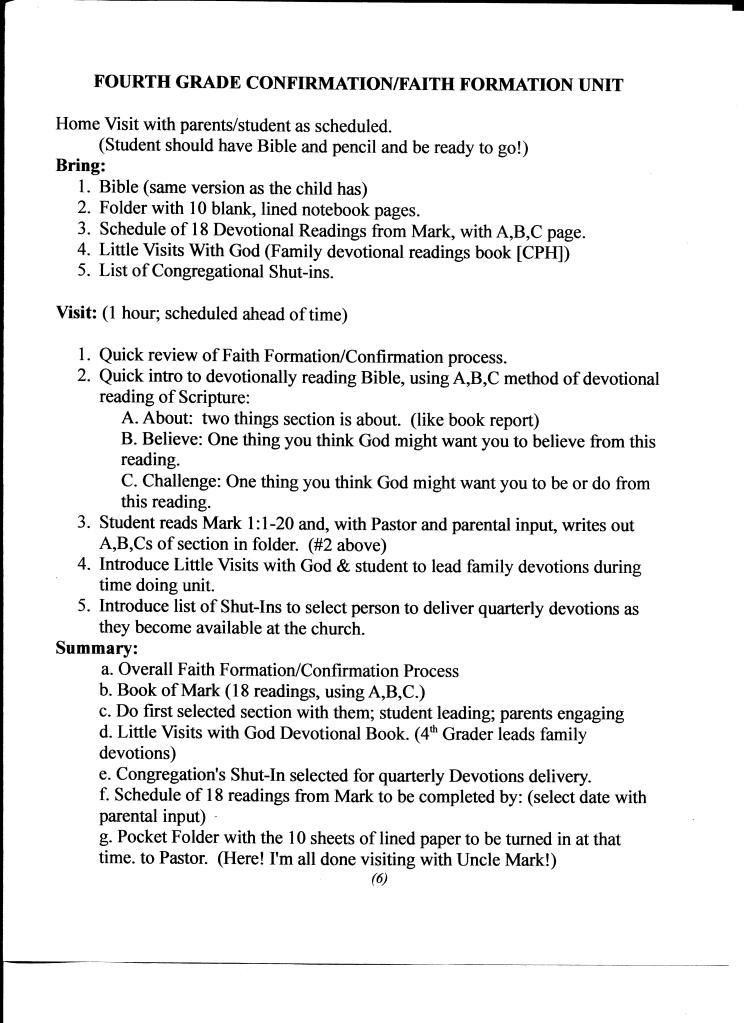
  • Pastor visits the home of each student to discuss personal and family devotions using selected readings from the gospel of Mark.
  • First Sunday in February: Lead congregation in Responsive Reading of the Psalm in Worship.

Serving:       

  • Deliver Devotional Booklets (large or regular print) to Shut-ins.

 TIF Unit*:      The Apostles’ Creed.

  • Parent/Student classes during Sunday School, last 2 Sundays in September and first Sunday in October.
  • Lead congregation in Apostles’ Creed on 2nd Sun in Oct.

*TIF Unit: “Together In Faith” as published by Augsburg Fortress at that time.
Lutheran Faith Formation: A New Vision for Lutheran Confirmation Ministry

CONSIDERING OUR PRESENT SITUATION

How would you describe the effectiveness, or the lack thereof, of present, so-called Traditional Confirmation processes?

To answer, consider this question?

What percentage of our High School Seniors are “functionally active” in our congregational life?

Meaning:

  1. Worshiping at least monthly? 
  2. Participating in any learning or serving dimension of the congregation? Including, post-Confirmation youth group?

Suggestion:  In answering this question, for context, please reference the photographs of your last three years’ Confirmands, and count.

Are we producing more “active participants in ministry”, ie., more young Disciples of Jesus Christ, sharing in His & our ministry?

Or more “audience members”, ie., more church members for the membership roster who may stop by on occasion?

According to the latest (though not that recent) national Lutheran assessment of Traditional Confirmation, meaning that it begins in grade 7 or 8, and concludes at the end of grade 9 or beginning of grade 10, the answer to the above question was:  Below 25% were functionally active by grade 12!*

According to best available research regarding New Vision/Family Centered Faith Formation Process:  Between 65% & 70% functionally active by Grade 12! **

Prayerfully reflecting on this information, how does one justify “Sticking with the traditional model?”

* Ken Pohlmann, Director for Confirmation Ministries, Division for life & Mission in the Congregation, ALC.

** Barna Research Group: Mark Holman, “Take It Home”, personal experience and consultation with other congregations using New Vision model.

Age Appropriate Approach

AGE APPROPRIATE LEARNING MODELS EMPLOYED

Model 1. 

At home, Family Centered Learning. (Grades 3-5)

Primary Learning of the faith centers in the at home, parent taught units, with direction, support and assistance from Pastor(s).

Model 2

Family centered with at home and at church learning. (Grades 6-7)

Learning that capitalizes on both home taught/learning and classroom and/or retreat learning with peers, parents and Pastor(s).

Model 3. 

Relational learning. (Grades 8-9)

Learning that gives relational learning with peers & Pastor at church, parents and students at home.  Using, in both settings the ABCW model of Scripture reading. 

Intentionally focusing on students, parents, peers and Pastor relating various ABCW written responses, as participants grow together.

Model 4. 

Supervised Learning. (Grade 10)

Students work in learning teams of 2-4 individuals using stud guides and resources available, under parental and pastoral supervision, with Reflection times as given learning team share what they have learned, in discussion with Pastor.

Model 5. 

Mentor-Intern Learning. 

Student selects Mentor (Congregational member), with parental approval, with whom to discuss, one on one, five aspects of living out one’s faith.  Faith and: Family, Vocation, Social Life, Congregation and concluding with My Faith & my Discipleship. 

Following each “session” sharing their learning with Parents, and Pastor.

Age Appropriate Approach

A CHILD’S DEVELOPMENTAL STAGES

Infants to Grade 5:  On Solid Ground    (Child)

Home, parents & family comprise their firm “base context” for almost all security,sense of belonging and of who the individual is as a person.  Primary “giving them roots” occurs during their years.  Self-image, relationships, life values & purpose are derived from the teaching, attitudes and behaviors of the family.  “How we do things” is how they should be done.

Near the end of grade 5 they the reach a riverbank where the terrain ahead is not so firm…

 Grade 6-9:  On the Ice Floes of the River   (Pubescent)

Individuals leave the terra firma of the riverbank to begin the river crossing.

Stepping onto the ice floes of the spring river, they begin a precarious journey across to who knows where.  These are transition years as children begin & complete the confusing years of life, as “home base” matters move from “givens” in life to questionable, even dumb and/or stupid.  Parents lose their role as

“answers to the questions” in life to being the questionable authorities.

Peers, media, teachers, neighbors & coaches all are likely to know more than parents.  Seeking and searching through all of the confusing messages

of life, sex, right & wrong, truth-telling and most everything else is up for grabs, as they randomly select what someone else says and thinks.   They are facing now this way, now that way on this or the next ice floe as they move forward. One day they make a statement that makes them sound rather  adult, and the next day they are acting like two year olds. Individual knows what/who they don’t stand for or believe; age of questioning everything.

Late grade 9/early grade 10 – 12:  Firmer ground/maturity; Identity of my own (Young Adult)

Maturity in this stage of life brings the individual to begin to seriously consider “Who am I?” and to establish what I believe, agree with and/or stand for.  Drawing from all of the influences of family, friends, peers and others, the individual begins to formulate, albeit, tentatively, who they want to be, do and live.  The ice floe life basically behind, as ideas, values & purpose begin to form as to this persons vision of him/herself in the world of young adulthood.  Questioning, experimentation and deciding values, faith, purpose begin to unfold.  Usually, not linearly, but in surges, regressing and readjusting manner.

Revisit and Improve the Current Confirmation Ministry

HOW DID WE GET HERE?

WHAT NEEDS TO BE REVISITED TO IMPROVE FAITH FORMATION

OF OUR YOUTH?

There are, as with so many such questions, multiple answers to that question as I see it. Primary among them, I would propose, that the whole process has been hijacked.

Hijacked, in significant part by clergy.  Supported, it seems by congregations.

I have no idea of when, how, why…but I know it is true.

Hijacked from original design for youth faith formation, which placed that responsibility

squarely, and solely, on parents.

Search the Scriptures.  Find there the number of references to the faith formation of the young one that charge clergy with that.  Also, check references to the role of parents…

Search Luther.  Have we noticed what the top of the page for each of the Six Chief Parts of the Small Catechism says is to do the teaching of these to the children? 

It is not “Clergy”.  It is “Head of Household”…Parents…

Baptism Service Event. “In Christian love you have presented this child for Holy Baptism…As s/he grows in years, you should place in his/her hands the Holy Scriptures and provide for her/his instruction in the Christian faith, that, living in the covenant of his/her Baptism and in communion with the Church, s/he may lead a godly life until the day of Jesus Christ..”  (Addressed to the parents of said child)  Response:  I do!

The process has been hijacked from its Scriptural and Lutheran intent to be the parents’ responsibility, and taken over by clergy.  Why, how or when would be interesting questions to pursue, but rather irrelevant if we are attempting to correct it.

When that is corrected, different outcomes do result.  This Faith Formation corrects that.

Secondly, near zero attention has been paid to the development of the child involved in this Faith Formation/Confirmation regarding beginning and ending age appropriateness. Simply stated, and further discussed on pages 3, 4, & back of folder, the present “Traditional Process”, and most of the modified ones afloat, both begin and end during the most turbulent and unsettled years of the child’s life!  Pubescence is, as we well know, a time of transition from childhood to young adulthood.  When we both begin and end the process during these years, knowing they are years of almost total uncertainty on the part of the child as to anything about which they are certain is almost a joke in any sense of “strategic planning” for the most significant commitment in the faith the child will make.  The problem is systemic and of our creation; not the fault of the child who is simply being what children are during this age span. 

We are doing it to ourselves, and we keep on, blindly pressing on; blaming the child for our poor and irresponsible choice regarding the age that is “right” for what we call Confirmation.

Take into Consideration Child Development Facts

Tracking the social, emotional, physical & spiritual development of youth will yield up some rather poignant realities not taken into account in the “traditional Confirmation Ministry model”,  beginning in grades 6-8 and ending in grades 8-10, if that means concluding in Fall of 10th grade. 

Reality is that the years of grades 6-9 are the most turbulent and restlessly unsettled years in any individual’s life.  As long as we persist in beginning and ending our process of Faith Formation during these years, regardless the educational skills and/or charisma of a given pastor, parents and/or mentors, virtually any model will fail abysmally.  And the fault is not that of the youth, but falls squarely on us, who continue to use such a faulted and irrationally chosen time line for our instruction intended to produce a “Life-long commitment to the faith we hold in Jesus Christ”; A Disciple.

“Train up a child in the way he should go; even when he is old he will not depart from it.” Proverbs 22:6 ESV

Child Discipleship Forum – Resilient Disciples

Why are kids leaving the church after high school?

This is the question that has been asked over and over again in the Lutheran Church. The Child Discipleship Forum on September 16 – 17th, 2021 deals with that question. In this forum, the statistics are presented by the Barna Group as well as innovative suggestions from experts on how to keep kids connected to faith and church after high school.

It is being presented both in person in Franklin, TN and online and it is very affordable.

Please check this out if you work with any age children in the church.

https://www.resilientdisciples.com/child-discipleship-forum/

Lutheran Faith Formation: Fourth Grade Curriculum

This is the first of the published curriculum for the Lutheran Faith Formation process. It is first because it is a good example of the age-appropriate nature of the process as well as the instructional and service components of the process. Families learning together and growing in faith is key to remaining connected to each other and to Jesus.

Please feel free to leave comments. I am new at this and we can use ideas for updated the curriculum. For example, if you know of another age-appropriate devotional book other than “Little Visits With God” please share by leaving a comment.

Also please ask questions. I may not be clear on somethings written here so ask for clarification if needed. Thank you!

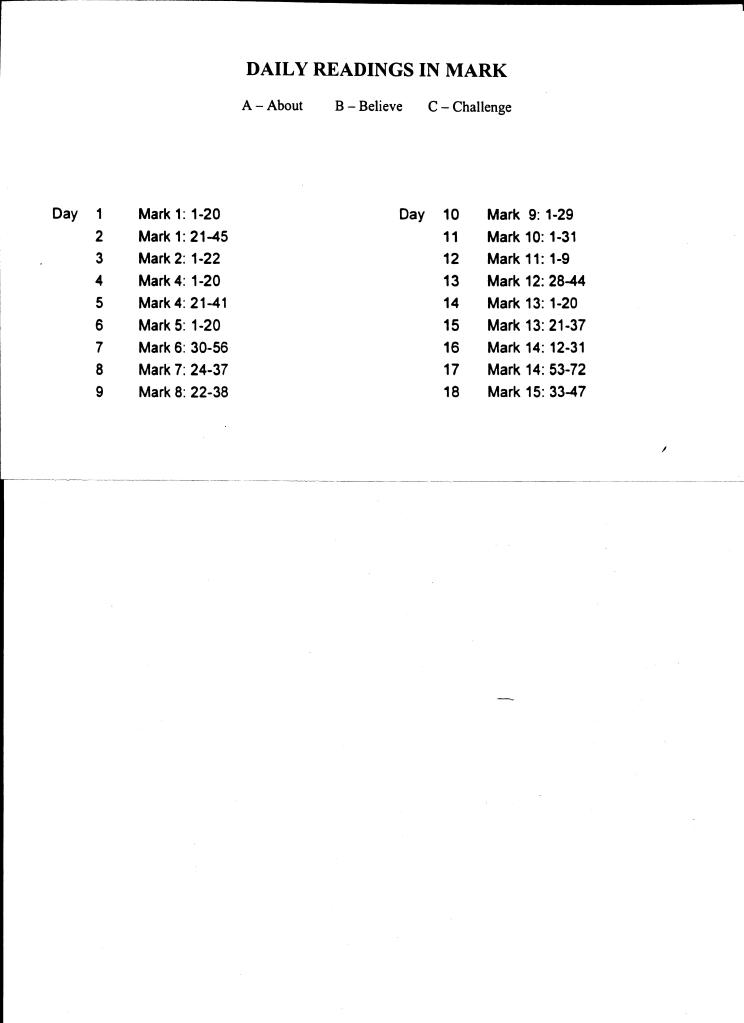
In Fourth Grade, children are learning to do book reports. So since they have received their Bibles in Third Grade, they begin reading it with their parents by looking at the Gospel of Mark and answering three questions:

A: What is it About?

B: What am I to Believe?

C: What Challenges me?

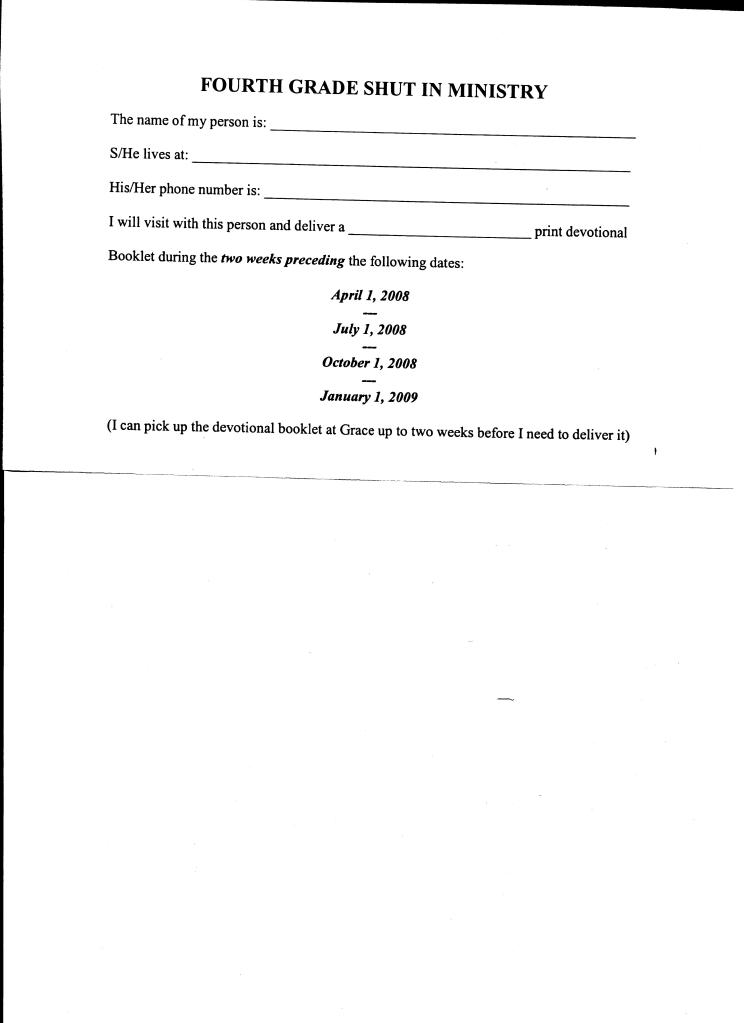
Below please find the information given to Fourth Grade families before they start reading the Gospel of Mark. As you can see there are two other elements: 1. Family Devotions lead by the child from “Little Visits With God”, 2. Visitation with Shut-ins to deliver a publication such as “Christ in Our Home” and pray together.

To the right is a sample of an information sheet that can be given to the families in the first group meeting with both parents and children.

To the right there is the 18 devotional readings from the Gospel of Mark that both parents and children do together.

The Pastor will visit the home once during this time period and see how the family is doing with these.

The time period could be six weeks with three readings in each week. Parents supervise the children and make sure the ABC questions are answered to their satisfaction.

If questions or problems occur, either the Pastor’s visit or a phone call to the Pastor may help throughout the process.

To the right is a sample of the shut-in ministry information and scheduling sheet.

Children and their parents meet and pray with the shut-ins every three months or as the publication of devotional takes place. This can be according to the schedule listed to the right, if appropriate.

By the way, Grace was the name of the Lutheran Church using this Faith Formation process with Fourth Grade families as seen in the parentheses at the bottom of the schedule.